
Fall Prevention Through T’ai Chi Principles ~ by Michael Stenson ~>
Timing and balance. The presence of both is experienced as poise – a graceful, light, stable bearing. Too often though, waning strength and balance disrupt timing leading to a fall. The purpose of this article is to show how timing and balance can be cultivated and spills avoided by practicing T’ai Chi.
T’ai Chi practitioners develop a keen sense of timing, balance, suppleness, strength and sensitivity through study of the slow, rhythmic exercises. T’ai Chi practice employs the mind by focusing attention on how to overcome inefficient physical habits and allow the body to work the way it was designed. To stand quietly without wobbling instead of bracing yourself up. To transition evenly and smoothly. To walk without faltering. T’ai Chi is a centuries old Chinese art whose basis is the application of common sense to movement and alignment.
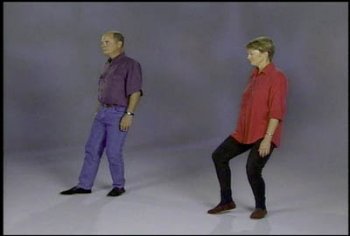 When walking in dim light, navigating curbs or negotiating stairs it is
best to move with a short step on a well placed foot. One of The Eight Ways To Graceful
Aging T’ai Chi exercises, Treading On Thin Ice, engages both body and mind in
the task by using the imagination and awareness to practice T'ai Chi principles while
performing the exercise.
When walking in dim light, navigating curbs or negotiating stairs it is
best to move with a short step on a well placed foot. One of The Eight Ways To Graceful
Aging T’ai Chi exercises, Treading On Thin Ice, engages both body and mind in
the task by using the imagination and awareness to practice T'ai Chi principles while
performing the exercise.
The most important T’ai Chi principle is relax. Relaxation enables the body to become supple and responsive, sensitive and agile – exactly the qualities needed to walk on ice. Relaxing is not the same thing as collapsing. A relaxed body is energetic, alert and alive – ready for anything. Energy sinks down into a relaxed body inducing a calm, composed, light-hearted feeling.
The principle of upright alignment is a refinement of relaxation. While treading on thin ice the knee of the weighted leg is always kept perfectly in line with the toes, hips are level with relaxed abdominal and lower back muscles, shoulders are neither collapsed nor thrust back and the classics say "the head is as if pressing against heaven". Working like this balances the body’s muscle pairs and tones the small balancing muscles closest to the joints. Simply standing like this exercises the muscle groups most crucial to independent mobility.
Treading On Thin Ice is one way to study the principle of separating the empty and full by placing the foot lightly as if to take a step, but without weighting it. Then slowly shift one hundred percent of the weight from the weighted leg to the empty leg all the while sensing the ability of the foot to stay firm and the ice to hold. An old cowboy I admire says, "The slower you go the faster you learn" He was talking about horses, and it is an equally deft approach for graceful transitions from the full leg to the empty leg.
The principle of turning only in the hips coordinates timing, smoothes transitions and maintains balanced alignment. Twisting the head, spine and knees to turn is very unstable so its no coincidence that most falls happen while changing directions. With practice, graceful turns transform treading to dancing on thin ice.
 T’ai Chi does not require any special clothes or equipment and the
principles can be practiced anywhere, anytime. The gentle exercises can be practiced by
anyone who can stand. Although skillful players make T’ai Chi appear to be
effortless, the exercises can also be very strenuous by increasing the bend in the hips,
knees and ankles to work lower. However, the importance of integrating the principles
correctly before working low can not be overemphasized as joints can easily be damaged by
the combination of sinking weight and misalignment. This is, in fact, the single most
important reason for finding a qualified teacher.
T’ai Chi does not require any special clothes or equipment and the
principles can be practiced anywhere, anytime. The gentle exercises can be practiced by
anyone who can stand. Although skillful players make T’ai Chi appear to be
effortless, the exercises can also be very strenuous by increasing the bend in the hips,
knees and ankles to work lower. However, the importance of integrating the principles
correctly before working low can not be overemphasized as joints can easily be damaged by
the combination of sinking weight and misalignment. This is, in fact, the single most
important reason for finding a qualified teacher.
Practicing the wrong thing, can be as bad as doing nothing at all. To avoid injuries, look for someone who can both demonstrate and teach the principles as outlined above.
Not everyone has the interest, ability or inclination to become a T’ai Chi student, yet many can benefit from learning to follow the principles, so look for workshops that truly meet your needs and interest.
There are many other long and short term health and well-being benefits that come from practicing T’ai Chi. The Chinese say that "whoever practices T’ai Chi regularly, over a period of time, will gain the pliability of a child, the health of a lumberjack and the wisdom of a sage."